Heat Pump vs. Gas Furnace: Which Makes Sense in Sacramento?
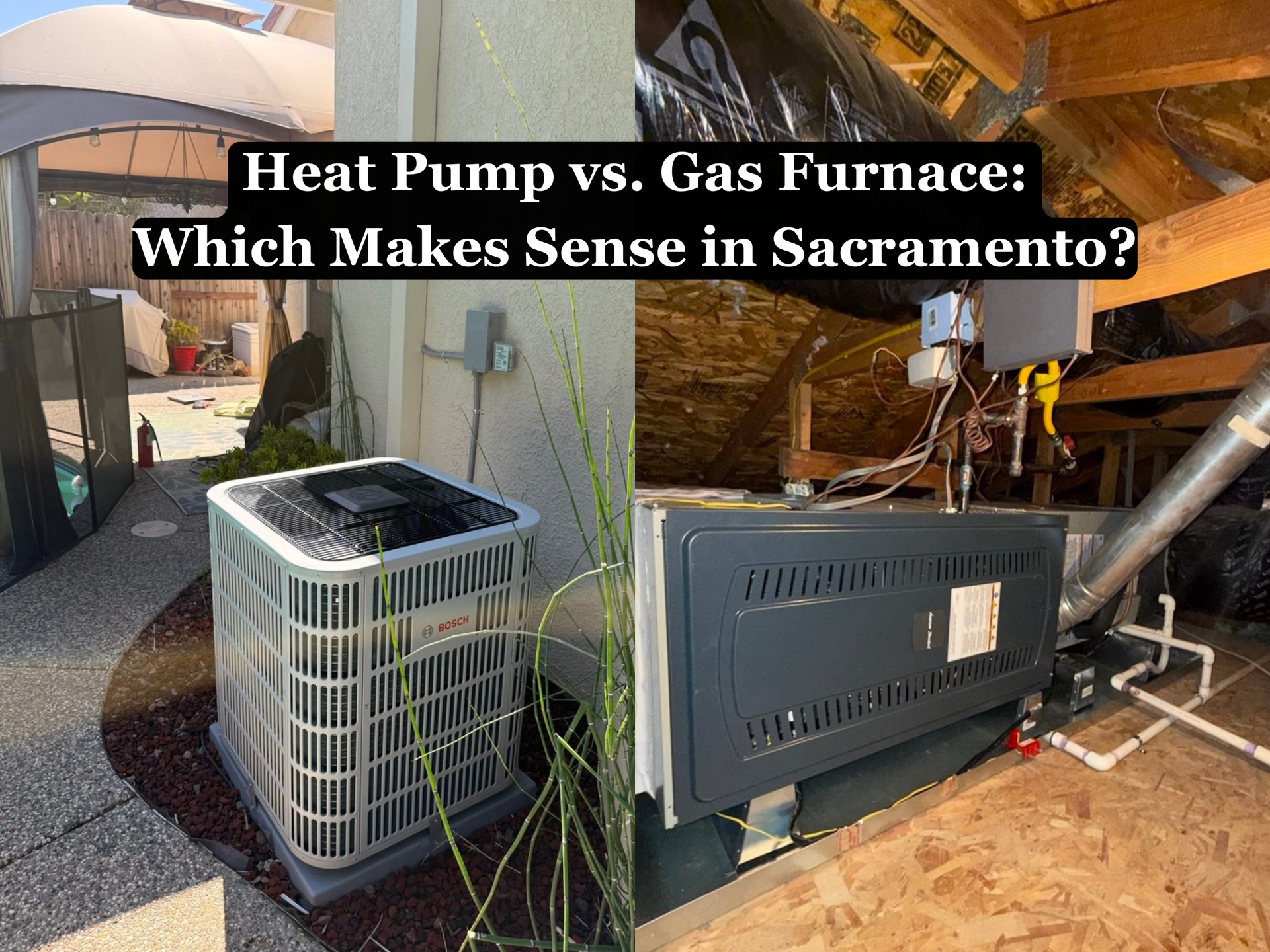
Heat Pump vs. Gas Furnace: Which Makes Sense in Sacramento?
If you're replacing your HVAC system in Sacramento, one of the biggest decisions you'll face is whether to install another gas furnace or switch to an electric heat pump.
Both can heat a Sacramento home effectively, but they work very differently. A gas furnace burns natural gas to create heat, while a heat pump uses electricity to move heat from one place to another. A heat pump also provides air conditioning, so one system can handle both heating and cooling.
So which makes more sense in Sacramento?
For many Sacramento-area homes, a modern heat pump is worth serious consideration because our relatively mild winters are well suited to heat-pump operation. However, a gas furnace can still make sense in certain situations, especially when the existing furnace is relatively new or when replacing it would add unnecessary cost to the project.
The right answer depends on the home, existing HVAC system, ductwork, electrical capacity, equipment selection, utility rates and available rebates.
What Is the Difference Between a Heat Pump and a Gas Furnace?
The biggest difference is how the two systems produce heat.
A gas furnace burns natural gas inside a heat exchanger. The furnace blower then moves air across the heat exchanger and distributes the heated air through the home's ductwork.
A heat pump does not create heat through combustion. Instead, it uses a refrigeration cycle to transfer heat.
During summer, it operates much like a traditional air conditioner by moving heat from inside the home to the outdoors.
During winter, the refrigeration cycle reverses. The system absorbs heat from the outdoor air and transfers it into the home.
Even when outdoor air feels cold, it still contains thermal energy that a heat pump can extract.
Do Heat Pumps Work Well in Sacramento?
Yes. Modern heat pumps can work very well in Sacramento's climate.
Sacramento has hot summers, but its winters are considerably milder than those found in many northern parts of the United States. That makes Sacramento a favorable climate for air-source heat pumps.
Modern two-stage and variable-capacity heat pumps are also significantly more capable than older generations of heat-pump equipment.
SMUD specifically states that modern multi-stage heat pumps can heat and cool effectively in Sacramento's climate.
That doesn't mean every heat pump will perform equally well.
Correct equipment selection and installation are extremely important. The contractor should consider the home's heating and cooling load, duct system, insulation, airflow and the manufacturer's heating-capacity data rather than simply replacing the old equipment with the same nominal tonnage.
Which Is More Efficient?
Heat pumps have an important efficiency advantage: they move heat instead of generating all of their heat directly.
According to ENERGY STAR, an air-source heat pump can deliver up to approximately three times as much heat energy as the electrical energy it consumes under appropriate operating conditions.
Gas-furnace efficiency is measured differently, using Annual Fuel Utilization Efficiency, or AFUE.
For example, a 95% AFUE furnace converts approximately 95% of the fuel's energy into useful heat over its rated seasonal test conditions, with the remainder primarily leaving through the venting system.
That does not mean a heat pump will automatically cost one-third as much to operate. Electricity and natural gas are priced differently, and actual operating cost depends on equipment efficiency, weather, thermostat settings, duct losses, utility rates and the condition of the home.
Efficiency and operating cost are related, but they are not the same thing.
What About Sacramento's Hot Summers?
This is an important part of the comparison.
A gas furnace only provides heat. A Sacramento home with a furnace typically also needs a separate air-conditioning system.
A heat pump provides both.
In cooling mode, an air-source heat pump operates using essentially the same refrigeration principle as a central air conditioner.
This means homeowners replacing both an aging furnace and an aging AC system can consider replacing the two functions with a heat-pump system.
For Sacramento homeowners, cooling performance should receive just as much attention as heating performance because of our long, hot summers.
What Does Heat-Pump Heating Feel Like?
Homeowners switching from a gas furnace sometimes notice that heat-pump heating feels different.
A furnace can deliver relatively hot supply air and then shut off once the thermostat is satisfied.
Modern variable-capacity heat pumps often operate for longer periods at lower output. Instead of repeatedly blasting very hot air, the system can continuously adjust capacity to maintain the indoor temperature.
That can provide more even temperatures throughout the home.
Neither operating style is inherently right for everyone. Some homeowners prefer the intense heat produced by a gas furnace, while others prefer the longer and more consistent operation of a variable-capacity heat pump.
Are There Heat-Pump Rebates in Sacramento?
For eligible SMUD customers, rebates can significantly change the economics of replacing a gas furnace and air conditioner with a heat pump.
As of 2026, SMUD lists the following incentives for qualifying HVAC installations:
- Up to $3,000 for a qualifying variable-stage heat-pump HVAC system when converting from gas to electric.
- $2,000 for a qualifying two-stage heat pump meeting SMUD's efficiency requirements when converting from gas to electric.
- $1,000 for qualifying electric-to-electric multi-stage heat-pump upgrades.
- Additional incentives of up to $2,000 may be available for certain electrical-panel and electrification improvements associated with an eligible gas-to-electric conversion.
Program requirements, qualifying equipment, funding and incentive amounts can change.
SMUD also requires qualifying HVAC rebates to be submitted through a participating contractor and establishes specific equipment and installation requirements.
Homeowners should therefore verify current eligibility before selecting equipment or assuming that a project will receive a particular rebate.
Does a Heat Pump Require an Electrical Panel Upgrade?
Not always.
One of the first things that should be evaluated during a gas-to-electric HVAC conversion is the home's existing electrical system.
A contractor should determine the required circuit for the proposed equipment and verify available panel capacity.
Some homes already have sufficient electrical capacity. Others may require a new circuit, electrical modifications, a subpanel or, in certain situations, a panel upgrade.
This is why an HVAC replacement estimate should involve more than looking at the old furnace's model number.
Can I Use My Existing Ductwork With a Heat Pump?
Often, yes—but it should be evaluated first.
Existing ductwork may have problems such as:
- Undersized supply or return ducts
- Excessive static pressure
- Air leakage
- Damaged or disconnected ducts
- Poor insulation
- Restricted filters or return-air pathways
- Incorrect register sizing
- Poor airflow to individual rooms
Installing expensive new equipment onto a poorly performing duct system does not fix the duct system.
Proper airflow is especially important for modern high-efficiency equipment.
Should I Replace My Gas Furnace if It Still Works?
Not necessarily.
Suppose your furnace is only several years old but your air conditioner needs replacement.
Removing a relatively new furnace solely because heat pumps are available may not make financial sense.
One option worth discussing is a dual-fuel system.
A dual-fuel system combines an electric heat pump with a gas furnace. The heat pump can provide cooling and much of the heating, while the furnace remains available as an alternative heat source.
For some homeowners, that offers a practical transition between conventional gas heating and an all-electric HVAC system.
If both the furnace and air conditioner are near the end of their useful lives, however, comparing a complete heat-pump replacement against another furnace-and-AC combination becomes much more relevant.
Heat Pump vs. Gas Furnace: Which Costs More to Install?
There isn't a responsible universal answer.
Installation cost depends on much more than the equipment itself.
Important factors include:
- System capacity
- Equipment efficiency
- Single-stage, two-stage or variable-capacity equipment
- Existing ductwork
- Electrical requirements
- Gas and venting modifications
- Refrigerant-line requirements
- Equipment location and accessibility
- Permitting and testing requirements
- Thermostat and controls
- Available rebates
- Additional work required to bring the installation into compliance
Two homes of the same square footage can require very different HVAC projects.
That is why an HVAC estimate should be based on the actual home rather than a price advertised for a generic "3-ton system."
What Size Heat Pump Does My Sacramento Home Need?
Square footage alone should not determine HVAC size.
A proper heating and cooling load calculation considers factors including:
- Home size
- Insulation
- Windows and doors
- Orientation and solar exposure
- Air leakage
- Ceiling height
- Number of occupants
- Duct location and condition
- Sacramento design temperatures
- Internal heat gains
Oversizing HVAC equipment "just to be safe" can create its own comfort and performance problems.
ENERGY STAR recommends determining equipment size using a Manual J heating-and-cooling load calculation.
When Does a Heat Pump Make the Most Sense?
A heat pump deserves serious consideration when:
- Both your furnace and air conditioner need replacement.
- You want to eliminate gas heating.
- You are already planning electrical upgrades.
- You want one system to provide both heating and cooling.
- Your existing equipment is old or inefficient.
- Your project qualifies for meaningful heat-pump incentives.
- You are interested in variable-capacity HVAC equipment.
When Can a Gas Furnace Still Make Sense?
A furnace may remain a reasonable option when:
- Your existing furnace is relatively new and in good condition.
- You are replacing only part of the HVAC system.
- Electrical modifications would make an all-electric conversion significantly more complicated.
- You specifically prefer gas heating.
- The existing home and HVAC configuration make furnace replacement substantially simpler.
The important point is that homeowners should not choose based solely on whether gas or electric equipment is "better."
The entire system and home need to be considered.
What About Dual Fuel?
There is also a third option.
A dual-fuel HVAC system combines a heat pump with a gas furnace.
During appropriate outdoor conditions, the heat pump provides heating. Under conditions established by the system's controls, the furnace can take over.
This configuration can be particularly interesting when a homeowner wants heat-pump technology but also wants to retain gas heating.
The economics depend on the equipment, utility rates, controls and installation.
So, Which Makes More Sense in Sacramento?
For many Sacramento homes replacing an entire aging HVAC system, a modern heat pump is a strong option because it provides both heating and cooling, operates efficiently in Sacramento's relatively mild winter climate and may qualify for substantial local incentives.
But that does not make a heat pump the correct choice for every house.
A newer existing furnace, electrical limitations, duct conditions, project budget, equipment selection and homeowner preferences can all change the recommendation.
A good HVAC contractor should evaluate those conditions before recommending either option.
The question shouldn't simply be:
"Heat pump or furnace?"
It should be:
"What HVAC system makes the most sense for this particular home?"
Frequently Asked Questions
Do heat pumps work when it's cold outside?
Yes. Modern heat pumps can continue extracting heat from outdoor air at temperatures far below typical Sacramento winter conditions. Actual heating capacity and efficiency depend on the specific equipment and outdoor temperature.
Does a heat pump replace both my furnace and AC?
An all-electric central heat pump can provide both heating and cooling and therefore can replace the heating function of a furnace and the cooling function of an air conditioner. Some homes instead use a heat pump together with a furnace in a dual-fuel configuration.
Are heat pumps good for Sacramento?
Sacramento's relatively mild winters make the region well suited to modern air-source heat pumps when the equipment is properly selected, sized and installed.
Can I keep my existing ducts?
Possibly. Existing ducts can often be reused, but they should be inspected for sizing, leakage, insulation and airflow before new equipment is installed.
Does SMUD offer heat-pump rebates?
Yes. SMUD currently offers incentives for qualifying heat-pump HVAC systems. Eligibility and rebate amounts depend on the equipment and type of conversion, and programs are subject to requirements and funding availability.
Do I need a new electrical panel for a heat pump?
Not necessarily. The existing electrical service and panel capacity should be evaluated before installation.
Is a heat pump cheaper to operate than a gas furnace?
It can be, but there is no universal answer. Actual operating costs depend on equipment efficiency, electricity and gas rates, weather, home efficiency, duct losses and how the system is operated.
How long does a heat pump last?
Service life varies considerably based on equipment quality, installation, climate, operating hours and maintenance. Because a heat pump provides both heating and cooling, its compressor may operate during more months of the year than a cooling-only air conditioner.
Need Help Comparing HVAC Options for Your Sacramento Home?
VM Heating & Cooling Services installs and services HVAC systems throughout the Sacramento area, including heat pumps, gas furnaces, central air-conditioning systems, ducted systems and ductless mini-splits.
Instead of recommending equipment based only on square footage or the system already installed, we can evaluate the existing equipment, ductwork, electrical requirements and project goals and discuss the available options and complete Heat Load Calculation.
For homeowners considering a gas-to-electric conversion, we can also review currently available rebate programs and qualifying equipment before the project moves forward.
Contact VM Heating & Cooling Services to schedule an HVAC estimate in the Sacramento area.
Rebate information in this article was reviewed in September 2026. Incentive amounts, eligibility requirements and program funding can change. Confirm current program requirements before purchasing equipment.